A Meditator Shoots a Fly with a Rubber Band and Pauses to Reflect

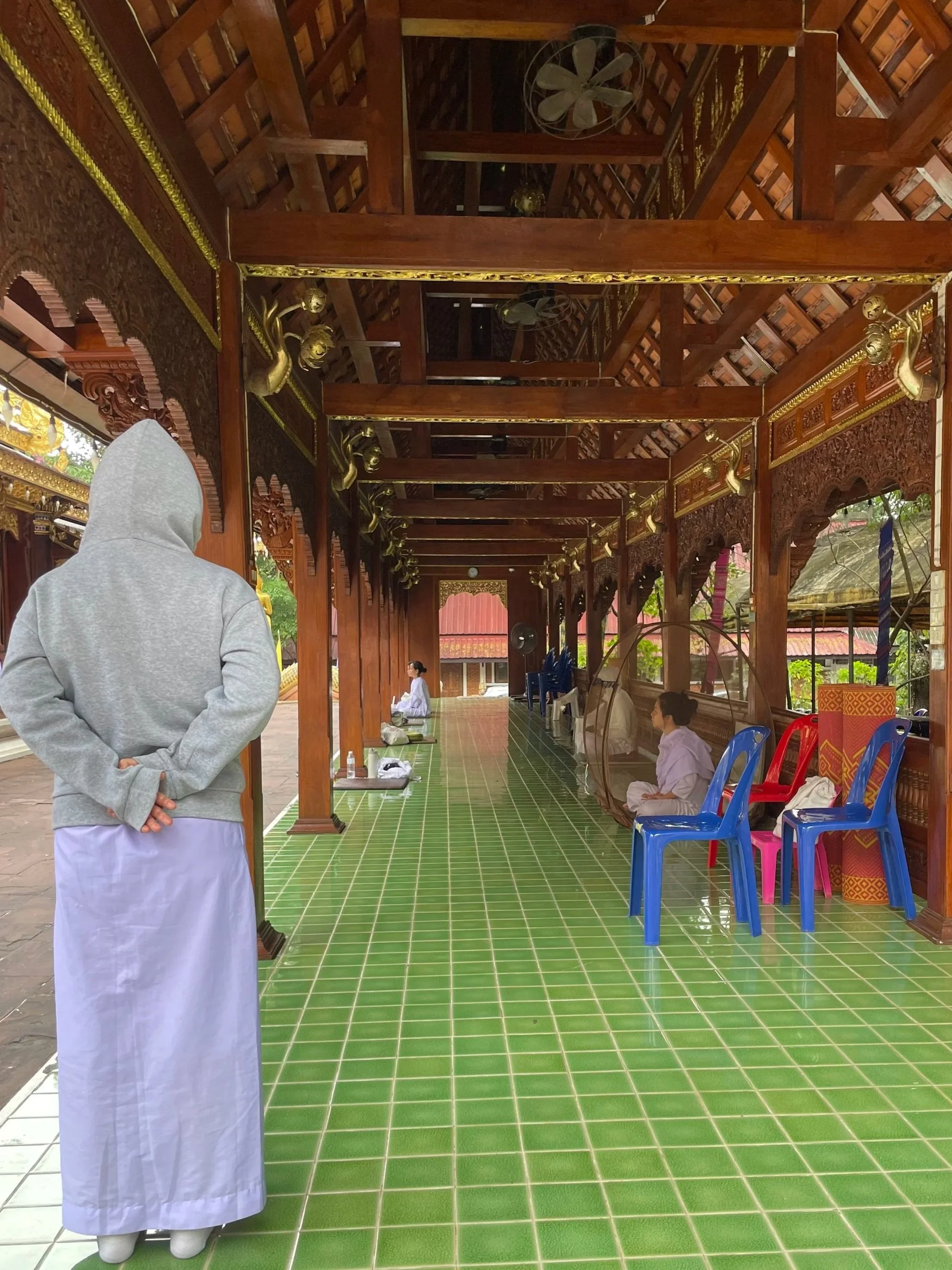
A temple in the Wat Ram Poeng monastery, Chiang Mai, Thailand, where the author found common purpose with a pigeon. December 2025. Credit: Carol Emert
I JUST SHOT A FLY with a rubber band and got to thinking about empathy – in particular, what causes it to arise sometimes and be completely AWOL at other times.
Last winter I did a monthlong meditation retreat in Thailand, during which I experienced some beautiful moments of empathy with a pigeon.
Also: ants.
December was unusually cold in Chiang Mai and most of the monastery is open to the outdoors. My mind-body was operating on a deep and slow level so it was easy to feel connected to the world beyond myself. In the crisp light of dawn, I noted a pigeon shivering on the roofline opposite where I was slow-stepping my walking meditation.
It was puffing out its feathers; I was hugging myself with a shawl. It had angled itself toward the gentle sun; I had chosen the brightest stretch of walkway. That pigeon and I were exactly the same, as far as I could tell. Different blobs of biomass in the same place and time with the same goals and strategies.
I felt so much kinship with that pigeon that it warmed my heart.
“A Buddhist monk in Southeast Asia, out of compassion for all beings, lies on the jungle floor one full day each year and allows the insects to suck his blood.”
Also: ants. They were all over the place. In my slow, steady state, I observed that they were purposeful. And that I was purposeful. They were doing their job: walking from here to there. I was doing my job: walking from here to there. I felt great respect for these industrious little beings and was careful to avoid stepping on them.
Mendicants in India’s Jain religion are famous for walking with brooms, sweeping insects from their path to avoid harming them. Even in my deepest meditative states (I have spent many months in silent Theravada Buddhist meditation retreats), I haven’t been tempted to go to such an extreme. But when I'm in a place of slow, quiet, open-heartedness, I can relate to the impulse.
Why then, sitting at my desk in Oakland, California, a few months later did I try to kill, or at least maim, a fly? It isn’t hurting me at all. It’s simply buzzing on the window and crawling through the hydrangea on my desk, manifesting its flyness just as I’m manifesting my humanness. It’s even a pretty, iridescent shade of green. In other contexts, I quite like this shade of green.
But I dislike flies. I associate them with germs and disease and swarmed cow paddies in Ohio, where I grew up. Flies all over the eyes of the luckless beef cattle. If a fly lands on my face or apple or the lip of my cup, I feel disgust.
“All of this is complicated, multi-layered, and pretty hypocritical, which I think is the right context in which to consider empathy.”
I’ve heard about a Buddhist monk in Southeast Asia who, out of compassion for all beings, lies on the jungle floor one full day each year and allows the insects to suck his blood. I can’t even imagine. No – full stop. Icky icky icky.
At the monastery in Thailand, and at a similar retreat in Malaysia last autumn, I was warned not to kill any mosquitoes that landed on me, but to swat them away. Never mind dengue. Never mind malaria. Never mind that if I die, my son is an orphan.
At meals, we were fed pork, fish, chicken, and other animal products. Vegetarian food was available, but less popular. The monks and nuns believe that bad karma only accrues to she who kills the animal. Smash a mosquito that’s biting you in a dengue-ridden province of Asia: very bad karma. Buy and eat a freshly slaughtered chicken: no harm and no (fowl) foul. For you, that is. But pity that poor, poor butcher! It will require many lifetimes for him to crawl out of that karma hole, according to my teachers.
All of this is complicated, multi-layered, and pretty hypocritical, which I think is the right context in which to consider empathy.
“The cockroaches in my room were just doing their job, skulking from here to there.”
A walking meditation platform at Wat Ram Poeng in Chiang Mai, Thailand. Ants were everywhere. December 2025. Credit: Carol Emert
The closer we feel to another being, the more we can relate to it, the more we value it, identify with it, and care about it. But if it causes us harm, or if we perceive that it could cause us harm, that connection is severed (or can’t arise – I suspect the mechanism is the former). It’s true for insects. It’s true for humans. It’s true for Democrats. It’s true for Republicans.
To be honest, I wasn’t thrilled with the flies in Thailand either. And the cockroaches in my room? They were just doing their job, skulking from here to there. But I never got past the revulsion.
When it comes to mosquitos, I decided to reject the teachings and, with mindful intention, kill any mosquito trying to make me a meal. I figure I’ll take the karmic hit, should there be one, for the sake of my own well-being and that of my son. It’s another, indirect way of practicing non-harming, in my view. And hey, I’m giving the mosquito a chance to be reborn as something less vile.
What of the fly at my desk? I got the rubber band within a couple of inches of its wee, soft body and: Blam-o! Direct hit. Five minutes later, either that fly or its genetic equivalent was back crawling around on my hydrangea with its hairy, germy, cow poo legs.
I named it Harold.